
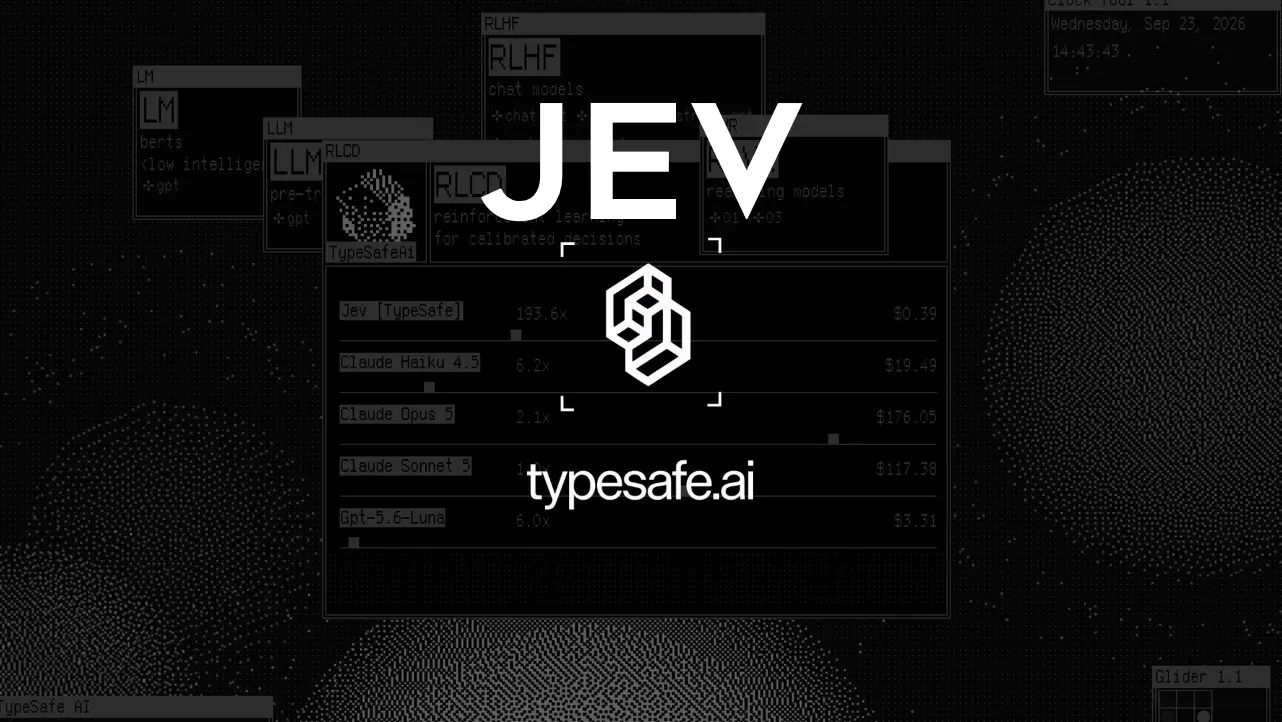
On September 15, 2026, TypeSafe AI introduced Jev — a new type of AI model that is not trying to compete with ChatGPT, Claude, or Gemini. Its job is much narrower and, for many businesses, potentially much more practical: making fast decisions within a predefined data structure.
The name Jev refers to the Jevons paradox: when a resource becomes cheaper and more efficient, people tend to use much more of it. TypeSafe expects something similar to happen with artificial intelligence. If an automated decision costs next to nothing, AI can start being used in parts of a business process where it previously made little economic sense.
How is it different from traditional AI models?
A conventional LLM receives a prompt and generates a response as text. This works perfectly well when you need to write an email, explain a document, generate code, or communicate with a customer.
But if a piece of software only needs a simple decision — which department should receive this enquiry, for example, or what score should be assigned to it — a large language model still has to generate text and then have the relevant data extracted from that text. Traditional LLMs are also not always particularly objective or consistent when used for this kind of scoring.
Jev works differently. It analyses information such as a customer message, order data, account history, or the current state of an AI agent and makes decisions within a predefined structure. Instead of returning a written response, the model returns a set of values — an object or array — that the software can use immediately.
For example, an online store receives this message:
“My order was supposed to arrive yesterday, I was charged twice, and support hasn’t responded for two days.”
Instead of producing a generic customer-service reply, Jev can determine within a fraction of a second:
department: billing
priority: critical
refund_risk: 0.81
human_required: 0.93
The CRM can then route the case to the billing team, mark it as high priority, and put it in front of a person who can make the actual decision. Later in the automation chain, a conventional LLM can write the customer response and provide an update on the case if needed.
That is the core idea behind Jev: an LLM can reason and write, while Jev decides what the system should do next — within clearly defined rules and a predictable format.
Real-world implementations
At ZaltsMan Media, we have already implemented this class of models in client projects, even though Jev itself has only just appeared. These projects show very clearly where this type of model becomes particularly effective.
A property portal in Spain
The catalogue contains tens of thousands of properties and more than ten filters: region, city, neighbourhood, price, number of bedrooms, floor area, terrace, swimming pool, sea view, distance from the beach, new development, and so on.
But users do not naturally think in filters. They are much more likely to write something like:
I’m looking for an apartment near Barcelona for a family with two children. Ideally three bedrooms, a large terrace, a modern building, and somewhere close to the sea. The budget is around €650,000. A sea view would be nice but isn’t essential, while being within 15–20 minutes of a good school is much more important.
The AI turns this normal human request into parameters that actually exist in the property database.
For example:
price_max        €650,000     high
bedrooms         3            high
property_type    apartment    high
terrace          yes          high
near_school      yes          high
modern/newbuild  preferred    medium
near_sea         preferred    medium
sea_view         preferred    low
The important part is not simply identifying the filters. The system also needs to understand how important each one is to the buyer.
If the catalogue contains five apartments that match the request exactly, the user sees those five. If there are no exact matches, the system does not push the customer away with the usual “no properties found” message. Instead, it gradually relaxes the least important conditions.
It might remove the sea-view requirement first. Then increase the acceptable distance from the coast. After that, it could slightly expand the budget or search area — while keeping three bedrooms and the other requirements the customer clearly identified as important.
The result is not an empty search page, but the closest available properties from the real catalogue.
A conventional LLM can also interpret this request. But when the same operation needs to happen on every search, sort, and refinement, a large generative model quickly becomes an unnecessarily expensive tool for the job.
This is exactly the kind of situation where Jev-style models make sense: the system needs to make ten small structured decisions against clearly defined parameters in a fraction of a second. A traditional LLM, designed to be helpful and conversational, can sometimes over-interpret the request, invent assumptions, or return something that does not strictly match the available data.
How Jev makes decisions
One of the key features is that the system works with probabilities and confidence levels.
This allows a business to define clear rules around automated decisions. If confidence is above 90%, the action can be executed automatically. Between 70% and 90%, it can be sent for an additional check. Anything below that can be escalated to a person. In practice, it becomes a very fast and inexpensive scoring layer.
TypeSafe trains Jev using its own Reinforcement Learning for Calibrated Decisions approach. The idea is that confidence should have real practical meaning: higher confidence should correspond to a higher probability that the decision is actually correct.
For a business, an AI system that understands the limits of its own confidence is much easier to integrate into an automated process than one that delivers the right answer and complete nonsense with exactly the same level of confidence.
Where Jev can be used in business
The most useful cases appear wherever employees make hundreds of similar small decisions every day.
- Sales and CRM. Jev can analyse an enquiry, identify the requested service, likely budget, urgency, and lead quality, and then route it to the right manager. With a high volume of incoming leads, the sales team can work on the most promising opportunities first. This is currently one of the areas where we are moving the largest number of our own projects to Jev-style models because the reduction in AI costs can be substantial.
- Customer support. Requests can automatically be divided into sales, billing, technical issues, returns, and complaints. The system can assess urgency and decide whether an automated response is enough or whether a person needs to get involved.
- E-commerce. The model can score return requests, suspicious orders, complaints, processing priority, or the probability that a specific case requires manual review.
- AI agents. Before an action is executed, Jev can decide which tool is most appropriate for the task, which model should be used, and whether the action should be allowed at all. It can also evaluate the output of another AI system before the software continues the workflow or sends a response to the customer.
As companies begin using several AI models and agents at the same time, they need a cheap decision layer that continuously answers small questions: What should run next? Is this action allowed? Is the result good enough? Does a person need to get involved?
TypeSafe itself describes this idea almost as a smart if-statement — an intelligent if inside ordinary application code.
Why not just use ChatGPT?
You can. And this is exactly how many AI automations are built today. The problem starts at scale. If an online store needs to classify 100 customer requests a day, the difference is almost irrelevant. If a system has to make several million small decisions, the latency and cost of a large LLM become critical. Depending on the workload, the cost difference can reach tens or even hundreds of times.
TypeSafe says Jev delivers response times of roughly 70–500 ms and costs $0.042 per million input tokens, with no charge for output. In its own workflow tests, the company reports results of up to 193.6 times faster and 444.6 times cheaper than conventional LLMs. At small volumes, that may not matter much. At millions of decisions, it changes the economics of the entire automation.
Jev is not a replacement for ChatGPT, Claude, or Gemini
Jev is simply not designed for tasks such as “write a sales proposal”, “create an article”, “analyse our strategy”, or “develop an application”.
It operates within a predefined decision space and is primarily focused on structured outputs and probability-based decisions. For text generation and open-ended reasoning, conventional LLMs are still the right tool. The better approach is to use both types of models together.
A large LLM can read documents, prepare a response, or suggest a course of action. Jev can evaluate the result, determine the risk category, and decide what should happen next. Then ordinary application code executes the action. At that point, you no longer have a simple AI chat interface. You have an automated business process.
What does this mean for your business?
Most companies still experience AI through something like ChatGPT: an employee asks a question, receives an answer, and then manually does something with it. That is useful, but it does not fundamentally change the process itself.
Jev represents a different direction for AI. The model may have no user interface at all and may never speak directly to a person. It simply operates inside a CRM, e-commerce platform, ERP, or support system and makes thousands of small decisions every day that employees previously had to make manually. The technology is already moving beyond TypeSafe’s own API. Jev is available through Vercel AI Gateway and OpenRouter, with integrations for AI SDK, TanStack AI, Cloudflare, and LangChain.
For us at ZaltsMan Media, this is one of the most interesting directions in business automation: finding the places where employees repeatedly sort enquiries, check information, distribute tasks, analyse incoming requests, and make the same routine decisions every day. If those decisions can be formalised into a clear protocol, the next stage of AI automation can happen almost invisibly to your team.

Mark Vi
Tech UI/UX Expert with over 15 years of experience
